When Does A Foundation Crack Need Repair In Hamilton?
Short answer: a foundation crack needs repair when assessment shows a water-control, durability, serviceability or structural objective that repair can address. The method depends on wall material, displacement, evidence of change, moisture and cause. Not every crack needs strengthening, and not every leaking crack is merely cosmetic.
Name the repair objective before selecting a product
“Fix the crack” can mean stop water, restore material, stabilize movement, transfer load or improve appearance. A product suited to one objective may do little for another. Write the objective in plain language and ask how the proposed work achieves it.
If the condition is uncertain, the next step may be assessment or monitoring rather than immediate permanent work. Delay is not appropriate where instability, falling material or rapid change is suspected.
Evidence that can support structural repair
- Measurable displacement or wall bowing.
- Reliable evidence of progressive movement.
- Deterioration that reduces the wall or connection.
- Loss of support at a footing, beam pocket or opening.
- Companion movement in floors, masonry or framing.
- A planned alteration that requires strengthening around the cracked area.
No single crack width or orientation establishes repair. Consequence, wall type and change over time matter.
When water repair may be separate
An aligned, stable crack may still leak and need sealing or exterior water management. Conversely, a dry displaced crack may need structural work. Assess water path, drainage and structure separately, then coordinate details so one repair does not block the other.
Interior injection, exterior membrane work, drainage improvements and grading have different scopes. Obtain material-appropriate advice and avoid claims that one method permanently solves every source.
Monitoring can be an active decision
Monitoring is not “do nothing” when it has defined references, frequency, duration and triggers. It can help establish whether a stable-looking condition changes. It is inappropriate as a substitute for urgent stabilization where risk is already evident.
If sale or renovation timing is short, acknowledge that the monitoring period may not capture seasonal or long-term behaviour. Do not describe a crack as stable merely because two readings taken close together match.
Compare repair proposals by mechanism
Ask each proposer to identify the observed condition, intended outcome, assumptions, preparatory work, connections, water coordination and limitations. A structural reinforcement proposal should explain how load reaches supports. A sealing proposal should explain which water path it addresses.
Watch for proposals that:
- diagnose cause from a photo without site context;
- use one standard spacing or material for every wall;
- ignore top, bottom or end connections;
- exclude drainage while promising no future water;
- cover the wall before required inspection; or
- offer a warranty whose exclusions are not explained.
Repair design and construction sequence
A buildable structural repair may need plans, sections, member or reinforcement details, connections, substrate preparation and temporary support. Existing material must be sound enough for the selected connections or be repaired as part of the work.
Construction can temporarily weaken the wall through drilling, excavation or material removal. The design should establish safe limits and a response to unexpected voids, reinforcement, water or deterioration.
Hamilton permit and inspection checks
Hamilton lists structural repairs and several foundation or drainage projects among work that can require a permit. Confirm the specific proposal through the current City permit page.
The City’s inspection guidance says required inspections must be booked and approved documents kept on site. Engineering review, when specified, is a separate scope and should occur before critical work is concealed.
Structural repair design must follow the current Ontario Building Code and verified construction. This article provides no generic reinforcement spacing or crack-size trigger.
A six-step decision framework
- Document: preserve dated photos, geometry, water and history.
- Screen urgency: restrict access and seek prompt help where instability is suspected.
- Assess: define wall construction, displacement, cause evidence and limits.
- Choose the objective: water control, monitoring, structural repair or a coordinated combination.
- Design and permit: prepare project-specific details and approvals.
- Verify and retain records: inspect required stages and keep completion evidence.
Example: repaired crack that reopens
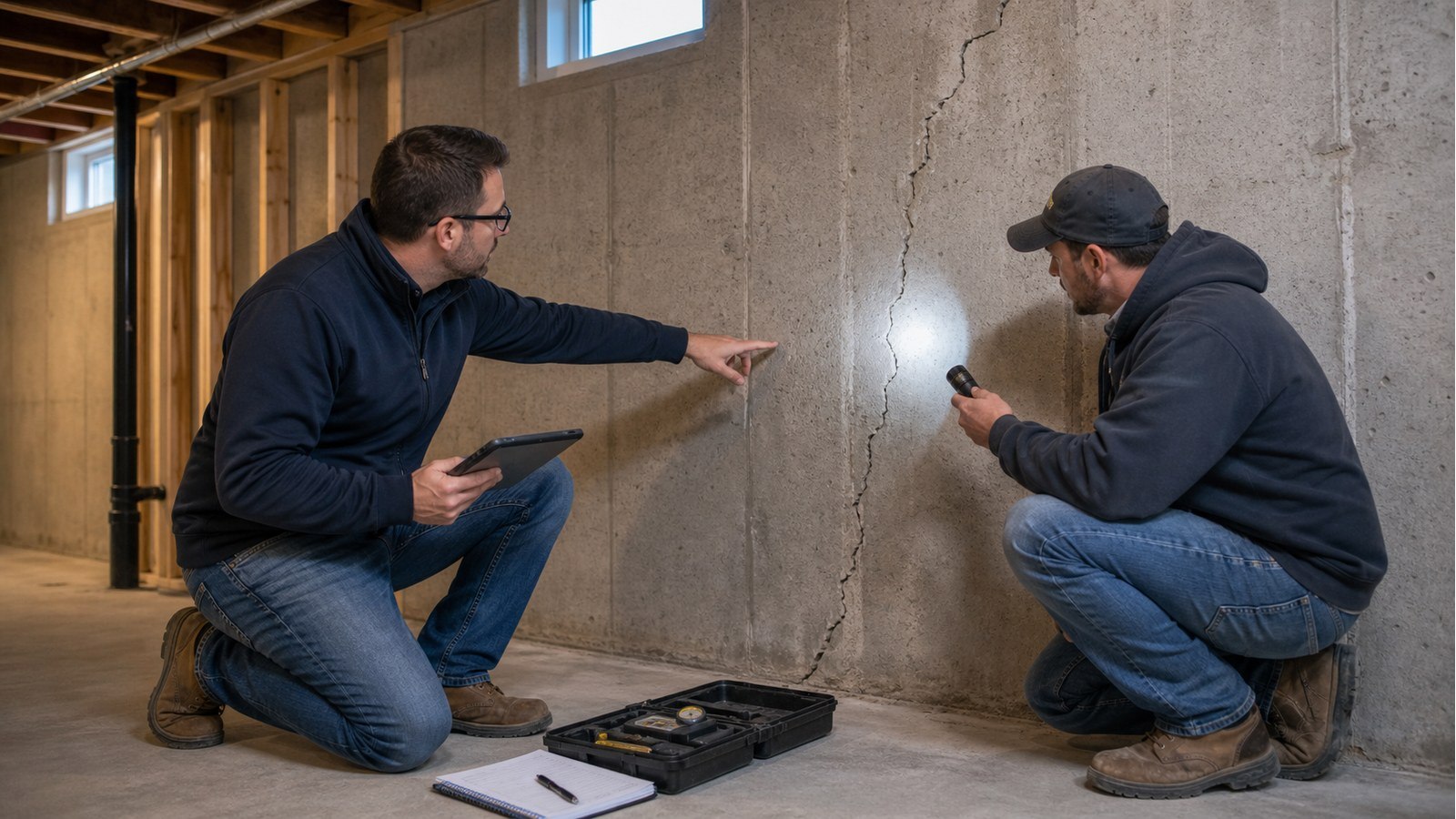
A vertical crack was patched for appearance and later reappears. Reopening can mean movement, bond failure or a repair unsuited to the material. Remove only what is needed for investigation, review related symptoms and avoid applying a stronger patch that simply shifts cracking elsewhere.
Hamilton services for repair decisions
Foundation inspections establishes condition and next steps. Structural foundations covers permanent stabilization or rebuilding design. Code compliance may be relevant where earlier repair is undocumented or deficient.
Repair-decision reading
- Are Horizontal Foundation Cracks Serious In Hamilton Homes?
- Can Water Leaks Cause Structural Foundation Damage In Hamilton?
- How Do Structural Engineers Monitor Foundation Movement In Hamilton?
Foundation repair FAQs
Can I repair a crack before an engineer visits?
Document and preserve it first unless immediate water or safety action is necessary. Early patching can hide displacement and material condition.
Does every structural crack need excavation outside?
No. Repair access and method depend on wall, cause, geometry and site constraints. Exterior work can introduce its own temporary risks.
Can a contractor choose an equivalent repair?
Material or detail substitutions should be reviewed where they affect the structural design. Similar appearance does not establish equivalent performance.
When is the repair complete?
When specified work, connections and required reviews are complete—not merely when the crack is covered. Retain permits, reports and photographs.
Need a crack repair decision? Request a quote with dated photos, history and any prior repair documents.